Topic Tags:
The compliance landscape for aged care has fundamentally changed, and the pressure is only increasing.
Under the Strengthened Aged Care Quality Standards (Standard 4), a spotless Reception and tidy resident rooms are no longer enough to satisfy auditors. Regulators are now looking deeper: at your documented processes, your infection control protocols, and the unseen risks hiding in utility rooms, linen cupboards and hand hygiene stations.
For providers still operating under the original 2019 framework, the window to prepare is narrowing. The transition to the strengthened standards, which consolidates environmental requirements under the newly defined Standard 4, raises the bar significantly, embedding infection prevention and control as a core, assessable component of your physical environment rather than an implied afterthought.
Whether you are consolidating your current practices or building toward full alignment with the strengthened framework, one thing is clear: mastering your environmental obligations is no longer optional; it is the foundation of safe, quality care.
What Changed When Standard 5 Became Standard 4
The shift from Standard 5 to Standard 4 is not simply a renumbering exercise. For many providers, it represents a meaningful lift in what the Commission expects to see, and more importantly, what they expect you to prove.
Under Standard 5, demonstrating a safe and comfortable environment was largely achievable through visual presentation and general good practice. Standard 4 changes the lens entirely. The question auditors are now asking is not “does this facility look clean and safe?” but “can this provider demonstrate that their environment systematically reduces risk?”
That distinction matters. A facility can pass a visual inspection and still fail Standard 4 if it cannot produce the documentation, the processes and the evidence behind what assessors are seeing on the day.
The table below translates the most common practices under the old framework into what is now specifically required.
| If you were doing this under Standard 5 | Standard 4 now requires this |
| Keeping the site visibly clean and comfortable | Show that cleaning reduces risk, follows a defined workflow and is matched to high-risk zones, touchpoints and outbreak scenarios. |
| Relying on general housekeeping routines | Document infection prevention and control measures clearly, including PPE use, clean-to-dirty sequencing, waste and linen handling, and staff hygiene practices. |
| Fixing maintenance issues as they appear | Prove there is a preventative system for inspections, servicing, fault reporting and follow-up before equipment or infrastructure fails. |
| Using older policy wording and audit templates | Update policies, SOPs, training materials and audit tools so they reflect the strengthened framework and current site practice. |
| Assuming a tidy environment demonstrates compliance | Produce operational evidence such as cleaning records, maintenance logs, staff training records, corrective actions and environmental risk reviews. |
What Providers Should Do Differently This Week
If your team is trying to translate the strengthened aged care standard 4 into action, start with a short operational review rather than a full policy rewrite. The first step is to walk the environment as a risk pathway, not as a presentation check. Look at corridors, bathrooms, utility areas, entrances, storage rooms, PPE stations, hand hygiene points and equipment storage. Ask where infection risk, trip risk, access problems or maintenance failures are most likely to emerge during an ordinary shift.
Next, compare what staff actually do with what your documentation says they do. Many providers have cleaning schedules, outbreak plans and maintenance logs on paper, but the day-to-day practice has drifted. If a cart is routinely parked in a corridor, if a hand sanitiser dispenser is empty, if a hoist is overdue for service, or if staff are mixing chemicals by estimation, the issue is no longer theoretical. It is an environmental compliance issue under the strengthened standard.
Then check whether environmental safety is shared across teams. Standard 4 is not owned by cleaners alone. Facilities, infection control, care, maintenance, hospitality and governance all shape whether the service environment is genuinely safe. If environmental issues only surface before an audit, the system is too reactive.
| Check | What to review first | What good looks like |
| Documentation | Policies, SOPs, training references and audit tools. | They refer to the current standards, reflect current workflows and clearly assign responsibilities. |
| Cleaning system | Frequencies, zoning, chemical dilution, linen and waste handling, PPE access. | Staff can explain the workflow and records show it is followed consistently. |
| Equipment safety | Hoists, mobility aids, rails, beds, trolleys, dispensers and cleaning equipment. | Equipment is fit for purpose, cleaned correctly, serviced on time and faults are escalated quickly. |
| Layout and access | Corridors, bathrooms, resident rooms, entry points, storage and outdoor access. | Older people can move safely and comfortably without avoidable obstacles or unsafe workarounds. |
Why the Cleaning Section Matters More Under Standard 4
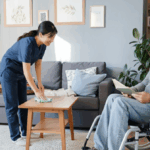
Cleaning has always mattered in aged care, but Standard 4 makes it much harder to treat cleaning as a housekeeping topic that sits off to the side. Under the strengthened framework, weak cleaning systems can undermine both parts of the standard at once. They can show the environment is not being managed safely, and they can expose a failure in infection prevention and control. Just as importantly, they leave providers without the operational evidence auditors expect to see.
That is why aged care compliance cleaning needs to be tied back to the operational intent of Standard 4. A cleaning program is not compliant because it makes the site look presentable. It is compliant when it reduces risk in the real environment, follows a defensible workflow and produces records that match what staff are actually doing.
| Compliance area | Auditor expectation | Why it matters under Standard 4 |
| Cross-contamination controls | Strict colour-coded cleaning systems and clean-to-dirty workflows. | Shows that infection prevention is built into the environment, not left to individual guesswork. |
| Chemical handling | Documented procedures and correct dilution ratios. | Demonstrates that the environment is being cleaned safely and consistently. |
| High-touch surfaces | Scheduled cleaning of door handles, rails, switches, taps and shared equipment. | These are the points where an apparently clean environment can still carry high transmission risk. |
| Equipment maintenance | Routine checks and service records for both care equipment and cleaning equipment. | Unsafe or poorly maintained equipment affects both physical safety and infection control. |
Real-world outbreak investigations show why this matters. In one long-term care facility outbreak investigation, researchers found widespread environmental contamination before facility-wide terminal cleaning, with toxigenic C. difficile identified in 19 of 50 environmental samples. That is the practical risk behind the workflow issues covered in the Australian infection control guidelines, which state that cleaning equipment should be cleaned and dried between uses, mop heads should be laundered daily, and cleaning carts kept separate between clean and soiled items. The point is not cosmetic cleanliness. It is whether the provider’s cleaning system reduces cross-contamination risk in a way that can be explained, followed and proven.

Preparing Your Facility for Future Assessments
The providers that respond best to the change from aged care standard 5 to aged care standard 4 are usually not the ones with the longest policies. They are the ones that can show the link between risk, routine and evidence. Their environment is easier to navigate, their cleaning system is safer to execute, and their records make the whole system easier to defend.
If that review exposes gaps in your cleaning workflows, audit readiness or infection control routines, Namoli Healthcare can help turn those weak points into a defensible system. Our teams support aged care providers with specialist healthcare cleaning, practical site-based auditing and hygiene processes built for compliance, so you are not just presenting a clean facility but maintaining one that stands up under scrutiny.
Related Posts